AP US Government Unit 5 Study Guide: Political Participation

By Knovli · October 2, 2026
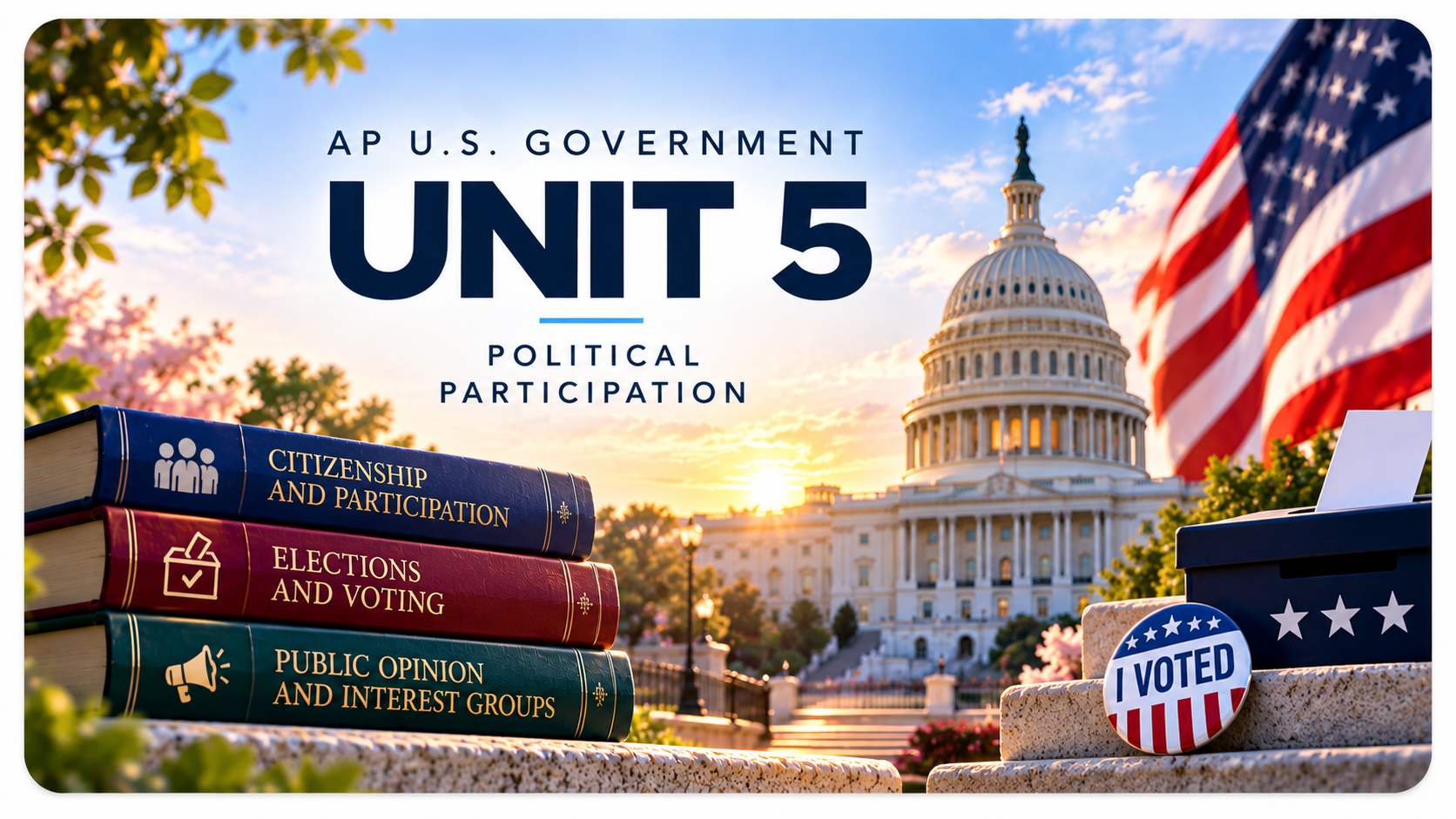
Master AP US Government Unit 5: voting behavior, elections, political parties, interest groups, and media. Key terms, exam tips, and free flashcard decks.
What Is AP US Government Unit 5?
Unit 5 — Political Participation — is one of the most heavily tested units on the AP US Government and Politics exam. It accounts for roughly 20–27% of the multiple-choice questions and is a common source of free-response prompts. The core question of the unit is: how do ordinary citizens connect to their government? The answer runs through five linkage institutions: political parties, interest groups, the media, elections, and campaigns.
Key Concepts at a Glance
- Linkage institutions — organizations and processes that connect citizens to government (parties, interest groups, media, elections)
- Political parties — recruit candidates, mobilize voters, and organize government
- Interest groups — advance specific policy goals through lobbying, PACs, and litigation
- The media — sets the public agenda and frames political issues
- Elections and campaigns — the formal mechanism of democratic participation
- Voting behavior — why people vote, how they choose, and who actually shows up
Political Parties
The United States has a two-party system, dominated by Democrats and Republicans. Third parties face structural barriers including winner-take-all elections and ballot-access laws. Know the difference between these party functions:
- Rational-choice voting — voters pick the candidate closest to their own policy positions
- Party-line voting — voters choose based on party affiliation, not individual candidates
- Realignment — a major, lasting shift in which groups support which party (e.g., the New Deal coalition, the Southern realignment)
- Dealignment — voters drifting away from both parties; rise of independents
The AP exam frequently asks you to compare the role of parties in elections versus their role in Congress. Keep those two roles conceptually separate.
Interest Groups
Interest groups try to influence policy without running candidates for office. The exam tests both their methods and their limitations.
- Lobbying — direct contact with legislators or executive agencies
- Amicus curiae briefs — written arguments filed with courts
- PACs and Super PACs — raise and spend money to influence elections; Citizens United v. FEC (2010) is a required court case here
- Grassroots mobilization — energizing members to contact representatives directly
- Collective action problem — large, diffuse groups are harder to organize than small, concentrated ones
The iron triangle — the relationship between congressional committees, interest groups, and executive agencies — is a classic AP concept. Know how to diagram it and explain why it resists outside pressure.
The Media
The AP exam focuses on three media concepts:
- Agenda setting — the media decides what issues the public thinks about
- Framing — the way a story is presented shapes how audiences interpret it
- Priming — repeated media coverage of an issue raises its weight in how voters evaluate politicians
Be ready to distinguish between traditional media (newspapers, broadcast TV) and new media (social media, podcasts, online news). The exam may ask how new media has changed political participation — think lower barriers to organizing but also increased polarization and misinformation.
Elections and Campaigns
Understand the full lifecycle of a presidential election:
- Primary elections — party members choose nominees; turnout is low and ideologically extreme voters dominate
- General election — nominees compete nationally; candidates often shift toward the center
- Electoral College — electors from each state cast the formal vote; winner-take-all in 48 states drives campaign strategy
- Campaign finance — hard money (regulated, direct donations) vs. soft money (less regulated, party/issue ads)
- Federal Election Commission (FEC) — enforces campaign finance law
Know the significance of Buckley v. Valeo (spending money = protected speech) and Citizens United v. FEC (corporations may spend unlimited independent expenditures). Both are required court cases.
Voting Behavior
Who votes, and why? These are central questions on the AP exam. Key factors that predict voter turnout:
- Education — the single strongest predictor of turnout; higher education = higher participation
- Age — older citizens vote at higher rates than younger ones
- Income — higher-income citizens participate more
- Civic duty — belief that voting matters increases turnout
- Mobilization — being contacted by a campaign or party raises the chance someone votes
Key factors that shape how people vote:
- Party identification — the strongest single predictor of vote choice
- Candidate characteristics — incumbency advantage, perceived competence, likability
- Issues and ideology — policy positions matter most to high-information voters
- Retrospective voting — did things get better? Voters reward or punish the incumbent party based on recent performance
Constitutional Amendments Connected to Unit 5
Several amendments directly expand political participation. You must know these for the exam:
- 15th Amendment — prohibits denying the vote based on race (1870)
- 17th Amendment — direct election of U.S. Senators (1913)
- 19th Amendment — women's suffrage (1920)
- 24th Amendment — abolishes the poll tax in federal elections (1964)
- 26th Amendment — lowers the voting age to 18 (1971)
Drill these with the Constitutional Amendments deck (27 cards) so you can recall the year and effect of each one instantly.
Flashcard Decks for Unit 5
These Knovli decks are built specifically for this unit. Use them in Study Mode to test recall, not just recognition.
- U5: Linkage Institutions — 108 cards — the most comprehensive deck for this unit; covers parties, interest groups, media, and elections
- U4: Political Beliefs and Behaviors — 52 cards — voting behavior, public opinion, and political socialization that feeds directly into Unit 5 topics
- Constitutional Amendments — 27 cards — essential for the suffrage amendments tested in this unit
Exam Tips for Unit 5
- Free-response questions love linkage institutions. Practice writing a paragraph that defines one institution, explains its function, and gives a specific example — all in under five minutes.
- Know your required court cases. Citizens United and Buckley v. Valeo appear constantly in Unit 5 prompts about campaign finance.
- Compare, don't just define. The AP exam rewards students who can explain why interest groups use litigation instead of lobbying in a given situation, not just students who can define both terms.
- Use real elections as examples. The 2020 and 2024 elections are recent enough to cite in free-response answers without risk — turnout records, social media's role, and Electoral College strategy are all fair game.
- Don't confuse PACs and Super PACs. PACs contribute directly to candidates (with limits). Super PACs spend independently and cannot coordinate with campaigns — this distinction is a common trap on multiple-choice questions.
Browse Knovli flashcard decks — free, no account needed to look.